
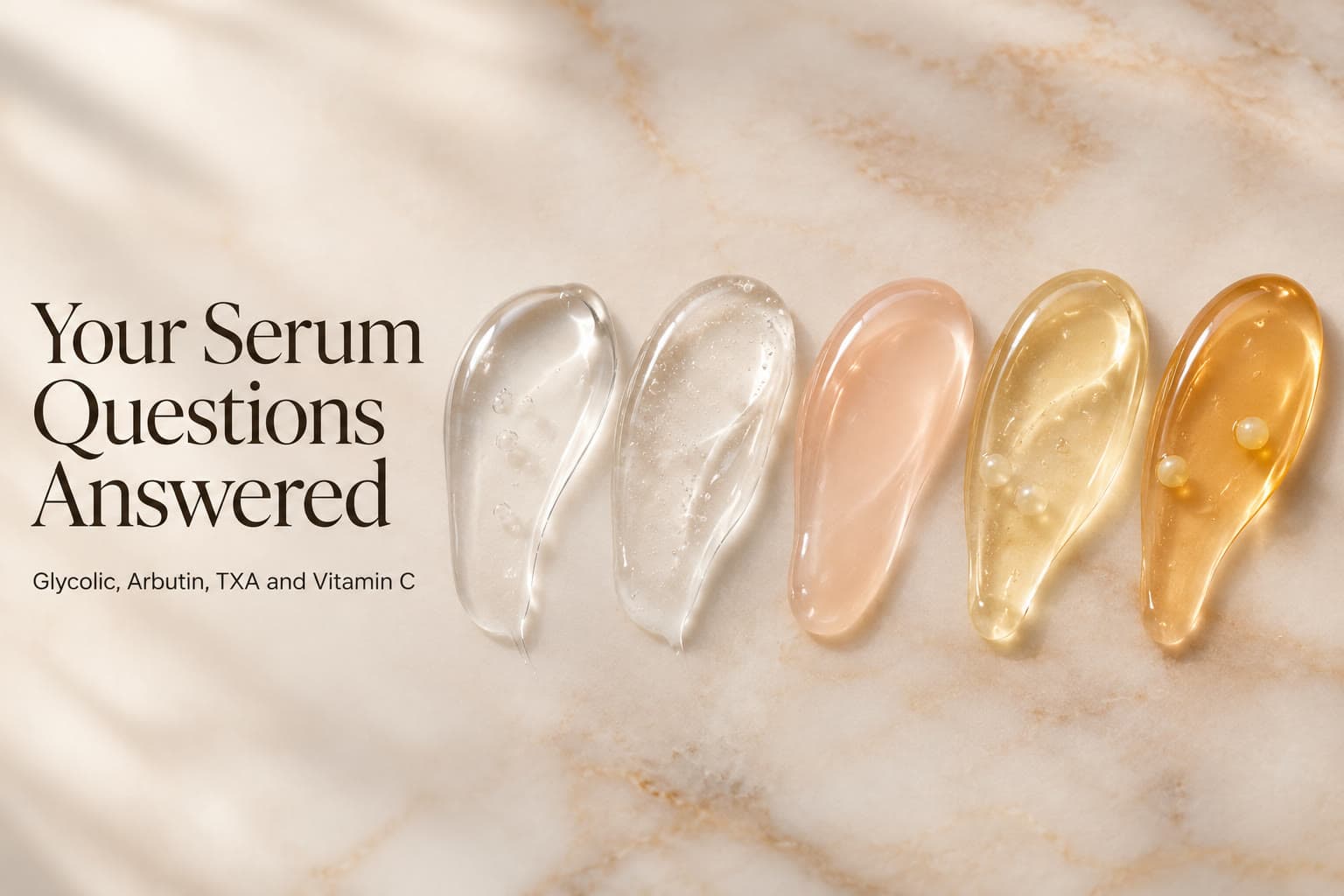
Two Big Questions, One Place
Two questions come up again and again when people shop for serums. The first: what does "encapsulated" actually mean? The second: how do you tell similar-sounding serums apart? Glycolic acid, alpha arbutin, tranexamic acid, TXA and vitamin C all appear on the COCOJOJO serum shelf, and at first glance they can blur together.
As a cosmetic chemist, I like to answer each question on its own, so this guide has two parts. Part 1 covers encapsulation, and it applies only to the serums named there. Part 2 compares five separate serums by their current labels, textures and directions.
Part 1: Your Encapsulation Questions
Capsule scope: in this article, encapsulation applies only to two formulas, TXA Dark Spot Corrector - 1 oz and Vitamin C Radiance Serum - 1 oz. Their product pages describe them as "Encapsulated tranexamic acid technology" and "Encapsulated 3X vitamin C technology." The other three serums in Part 2 are not described as encapsulated, so nothing in this section applies to them.
What does encapsulation mean in these serums?
Selected ingredients are held inside tiny capsules within the formula. The capsules help protect the ingredients inside until use, when you dispense the serum and apply it.
Which ingredients are encapsulated?
In TXA Dark Spot Corrector, the page names encapsulated tranexamic acid. In Vitamin C Radiance Serum, the page describes an encapsulated triple vitamin C system.
Does encapsulation change how I apply the serum?
No. You simply follow each label:
- TXA Dark Spot Corrector: cleanse and pat dry, measure out 2 to 3 drops, dab one drop onto dark spots first if you want targeted care, then spread the rest across the face and neck. Follow with moisturizer, and in the morning apply broad-spectrum sunscreen. Use morning and/or evening.
- Vitamin C Radiance Serum: cleanse in the morning and pat dry, apply 2 to 3 drops over the face and neck, let it absorb for a minute, then moisturize and apply sunscreen. Morning use is recommended, and the page notes you can add an evening application if you like.
Why does the vitamin C serum use derivatives?
The product page explains that L-ascorbic acid breaks down quickly once exposed to air, light and water. Vitamin C Radiance Serum uses three vitamin C derivatives chosen for stability: 3-O-ethyl ascorbic acid, ascorbyl glucoside and tetrahexyldecyl ascorbate. Ferulic acid, tocopherol, ubiquinone and glutathione add antioxidant support.
How should I store them?
Both pages say the same thing: keep the bottle tightly closed in a cool, dry place away from heat and direct sunlight. For vitamin C, the page suggests a drawer or cabinet rather than a sunny bathroom shelf.
Part 2: How to Tell Five Serums Apart
Each of these is a separate formula with its own product page and its own directions. Here is how they differ, taken from each current label.
Glycolic Acid Serum - 1 oz: Measured Exfoliation
Glycolic Acid Serum - 1 oz is an AHA exfoliating serum. Key ingredients: glycolic acid, aloe leaf water, hyaluronic acid, ginseng and Tasmannia extract. It comes in an opaque bottle with a precise dropper that helps protect the formula from light exposure.
- Amount: 1 to 2 drops on clean, fully dry skin, avoiding the eye area and lips.
- How often: 2 to 3 times weekly, preferably in the evening, followed by moisturizer.
- Good to know: AHAs may increase the possibility of sunburn, so the page asks for broad-spectrum sunscreen daily while using it and for a week afterward. It also suggests using glycolic acid and vitamin C at different times rather than in the same routine.
Alpha Arbutin Serum - 1 oz: Gentle Brightening Without Acids
Alpha Arbutin Serum - 1 oz is a clear, lightweight watery gel with a non-sticky finish, and it is unscented. Key ingredients: high-purity alpha-arbutin, glycerin, hyaluronic acid and panthenol. The page lists it for people who want a brightening step that does not rely on acids.
- Amount: 1 to 2 drops over the face and neck, or pressed onto targeted areas.
- How often: morning and/or evening, followed by moisturizer and SPF.
Tranexamic Acid Serum - 1 oz: A Simple Tone-Care Formula
Tranexamic Acid Serum - 1 oz is a clear, lightweight gel-serum with a non-sticky finish, and it is unscented. Key ingredients: tranexamic acid, niacinamide, panthenol and hyaluronic acid. The page lists it for people who prefer tone care without exfoliating acids or peeling.
- Amount: 2 to 3 drops over the face, with a little extra attention on areas that look uneven.
- How often: morning and/or evening. Seal with moisturizer, and follow morning use with broad-spectrum sunscreen.
TXA Dark Spot Corrector - 1 oz: A Spot-Focused, Encapsulated Formula
TXA Dark Spot Corrector pairs encapsulated tranexamic acid with niacinamide, alpha-arbutin and N-acetyl glucosamine. Glutathione and licorice root extract add brightness, while panthenol, allantoin and sodium hyaluronate keep daily use comfortable. Its directions, covered in Part 1, include dabbing one drop directly onto dark spots before spreading the rest.
Vitamin C Radiance Serum - 1 oz: Your Morning Antioxidant Step
Vitamin C Radiance Serum is built for mornings, under moisturizer and sunscreen. Besides its three vitamin C derivatives, it contains niacinamide, alpha-arbutin and sea buckthorn fruit extract to help even the look of tone. The page lists it as suitable for all skin types, including oil-prone skin that prefers fluid textures.
Tranexamic Acid Serum vs TXA Dark Spot Corrector
The names sound alike, but these are two separate formulas with two separate product pages:
- Tranexamic Acid Serum - 1 oz is a short, simple formula: tranexamic acid with niacinamide, panthenol and hyaluronic acid. It is not described as encapsulated.
- TXA Dark Spot Corrector - 1 oz uses encapsulated tranexamic acid inside a wider tone-focused team, and its directions include a targeted dab on dark spots.
Both use 2 to 3 drops, morning and/or evening, but always read the page of the exact product you bought. One is not a refill or a stronger version of the other.
Do You Need All Five? No.
Please do not stack all of these actives in one routine. More is not better, and the pages themselves point toward measured routines: glycolic acid only 2 to 3 evenings a week, vitamin C in the morning, and glycolic acid and vitamin C at different times. The TXA Dark Spot Corrector page also advises adding new actives one at a time so you can see how your skin responds.
A simpler way to choose is to start with one goal:
- Smoother-looking texture: Glycolic Acid Serum.
- Gentle brightening without acids: Alpha Arbutin Serum.
- Simple tone care without exfoliating acids: Tranexamic Acid Serum.
- Spot-focused tone care: TXA Dark Spot Corrector.
- A morning antioxidant step: Vitamin C Radiance Serum.
Whichever you choose, the same basics apply to all five: patch test on the inner forearm for 24 hours before first use, use externally only, stop if irritation occurs, and wear broad-spectrum sunscreen every day.
Find Your Serum
Ready to choose? Start with the one that matches your goal: Glycolic Acid Serum - 1 oz, Alpha Arbutin Serum - 1 oz, Tranexamic Acid Serum - 1 oz, TXA Dark Spot Corrector - 1 oz or Vitamin C Radiance Serum - 1 oz. Each COCOJOJO product page lists its ingredients and directions, so you know exactly what you are putting on your skin. And if you want the bigger picture on capsules, read our introductory technology article, What Are Those Tiny Capsules? Meet COCOJOJO Encapsulated Creams and Serums.