
Introduction
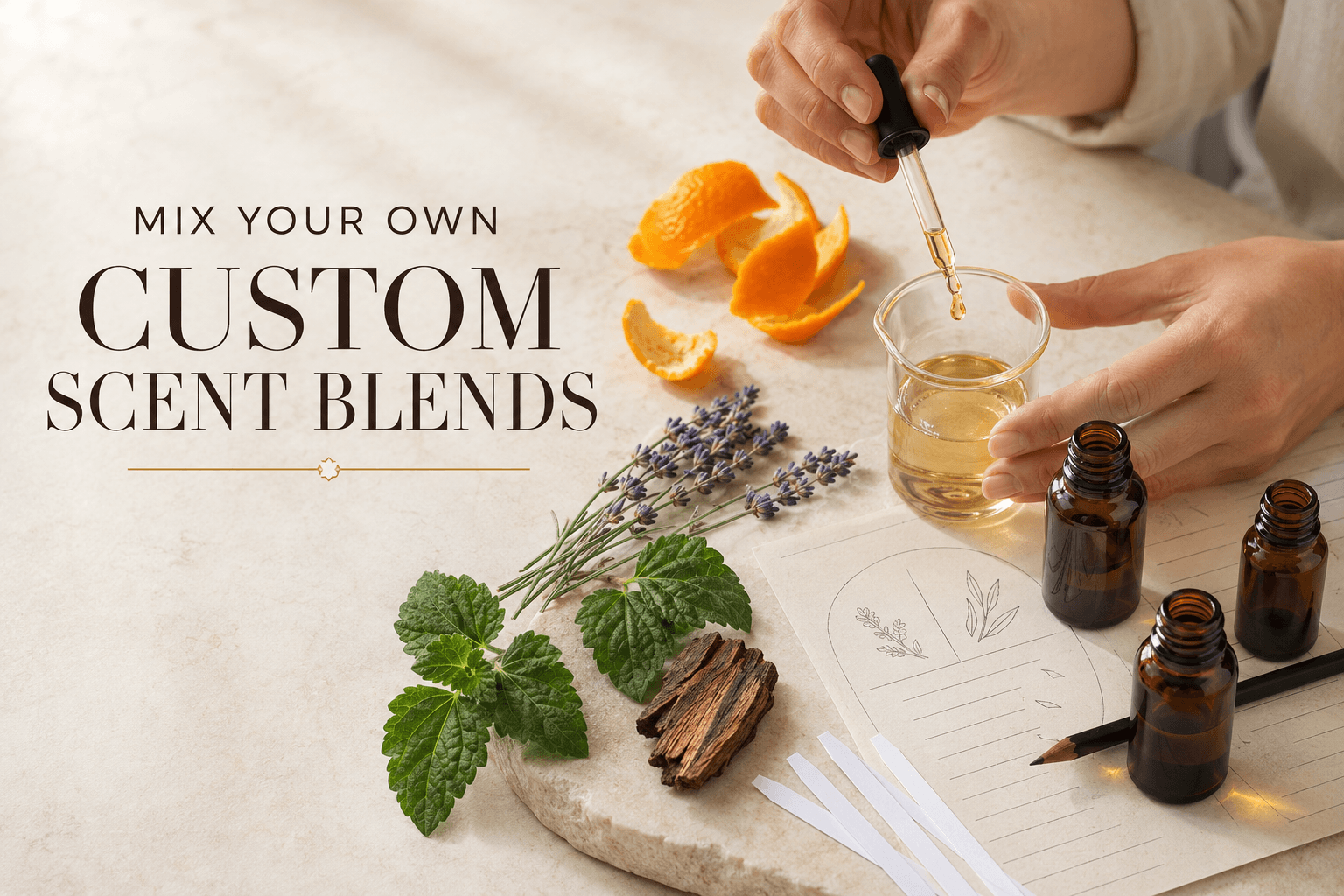
What if your favorite scent did not come from a store shelf, but from your own imagination? Creating custom scent blends at home lets you control whether your fragrance feels fresh, floral, warm, woody, sweet, or completely unexpected.
The secret is not using dozens of ingredients. It is understanding how a few aromas work together. With three oils, blotter strips, a small bottle, and careful notes, you can begin building a scent that feels personal and balanced.
Start by exploring the COCOJOJO Essential Oil collection, then choose one bright note, one central note, and one deeper note for your first experiment.
Choose the Intended Use Before You Start
A scent concentrate created for smelling on a blotter is not automatically suitable for skin, a diffuser, a candle, or a room spray. Each application requires different concentrations and safety considerations.
For your first experiment, create a tiny evaluation blend that will only be tested on perfume blotter strips. This allows you to study the scent without committing to a larger formula.
Once you like the aroma, you can decide whether you want to develop it into a body oil, personal fragrance, diffuser blend, or another scented product. That decision should always come before determining the final concentration.
Understand Top, Heart, and Base Notes
Most successful scent blends have movement. They smell one way when first opened, develop a central character, and leave a softer aroma behind.
Top notes provide the opening impression. They are often fresh, citrusy, green, or lightly herbal. Sweet Orange Essential Oil can bring a juicy, cheerful opening to a beginner blend.
Heart notes, sometimes called middle notes, form the central personality of the scent. Floral, herbal, and gently spiced aromas often belong here. Lavender Essential Oil creates a soft botanical heart that pairs naturally with citrus and woody notes.
Base notes provide depth and help the blend feel more complete. These aromas may smell woody, earthy, resinous, or warm. Patchouli Essential Oil is a powerful base note, so even one drop can influence the entire formula.
These categories are helpful guides, but oil strength varies. A single drop of a strong base note may be more noticeable than several drops of a delicate top note.
Gather a Simple Home Blending Kit
You do not need professional laboratory equipment for your first small scent experiment. Prepare:
- Three carefully selected essential oils
- A small dark glass bottle
- Separate disposable pipettes
- Perfume blotter strips
- Small adhesive labels
- A notebook or scent journal
- A clean glass dish or beaker
Keep each pipette assigned to one oil to prevent contamination. Label every trial immediately with its ingredients, number of drops, and date. A blend you love will be difficult to recreate if the formula was never recorded.
Before buying oils, you may also want to read Real vs. Fake Essential Oils: 9 Signs to Check for practical guidance on labels, botanical identity, packaging, and sourcing.
Try This Six-Drop Beginner Scent Accord
Begin with a tiny six-drop test:
- 3 drops Sweet Orange Essential Oil
- 2 drops Lavender Essential Oil
- 1 drop Patchouli Essential Oil
Add the oils to a small glass bottle and swirl gently. Label the bottle with the complete formula and date.
Place one drop of the finished accord on a blotter strip. Smell it immediately, again after 15 minutes, and once more after one hour. The bright orange opening should gradually reveal lavender, followed by a subtle earthy finish.
Close the bottle and let the blend rest for 24 to 48 hours before evaluating it again. Aromatic materials can interact over time, so a freshly mixed formula may smell different after resting.
This formula is for scent evaluation on blotter strips. Do not apply the undiluted test accord directly to your skin.
Adjust Only One Part at a Time
A common beginner mistake is adding several extra drops at once. This makes it almost impossible to understand what improved or disrupted the formula.
If the blend feels too sharp, try adding one heart-note drop to a new trial. If it feels flat, introduce one additional top-note drop. If the scent disappears too quickly, test a small increase in the base note.
When a blend becomes too heavy, create a fresh version with less base material instead of repeatedly adding more top notes. Starting again often produces a cleaner result than trying to rescue an overcrowded formula.
Keep each variation separate and name it clearly, such as Trial A, Trial B, and Trial C.
Smell the Blend in Stages
Do not judge a fragrance by smelling directly from the bottle. The concentrated vapor can overwhelm your nose and hide the relationship between the notes.
Apply the blend to a blotter and evaluate it in stages:
- Opening: Smell immediately to evaluate the top notes.
- Development: Smell after 15 to 30 minutes to find the heart.
- Drydown: Smell after one to three hours to evaluate the base.
- Final check: Revisit the strip later to see what remains.
Take short breaks between samples. Fresh air helps prevent olfactory fatigue, which occurs when your nose temporarily becomes less responsive to an aroma.
Turn Your Accord Into a Body Oil Carefully
A pleasant test accord is not automatically a finished topical formula. Essential oils are concentrated, and suitable limits depend on the exact material, extraction method, intended product, and area of application.
Check the supplier’s current usage directions and consult the official IFRA Standards, which restrict certain fragrance materials according to their intended use. Some citrus oils also require additional light-exposure precautions depending on their composition and extraction method.
For an oil-based product, a carrier such as COCOJOJO Unrefined Jojoba Oil can provide a smooth, lightweight base. However, do not assume one universal drop ratio works for every essential oil.
Prepare a small batch, patch test the diluted formula, and stop using it if irritation occurs. Keep essential oils away from the eyes, lips, inner nose, broken skin, and other delicate areas. Do not ingest them.
For a related formulation idea, visit How to Make a Soothing Homemade Body Oil for Dry Skin.
Avoid Mixing Essential Oils Directly Into Water
Essential oils do not dissolve evenly in water. A homemade spray made only with water and essential oils can leave concentrated droplets on the skin or other surfaces.
Water-based products normally require suitable solubilization and preservation systems. If you want to make a room spray, body mist, or other water-based formula, use a professionally developed base or seek qualified formulation guidance.
For diffusers, follow the device manufacturer’s instructions, use the blend in a ventilated space, and consider the sensitivities of children, pets, and other household members.
Build a Recognizable Scent Style
Once you understand the basic formula, begin creating small variations.
For a brighter blend, let citrus lead while keeping the base note minimal. For a soft botanical blend, make lavender the central focus. For a deeper scent, slightly strengthen the base while keeping enough top note to prevent the opening from feeling heavy.
The COCOJOJO range of essential oils makes it easier to explore different scent families without beginning with an overwhelming number of materials. Add one new oil at a time and compare it with blends you already understand.
Common Scent-Blending Mistakes
Using too many oils can make a blend smell confused. Begin with three materials and expand only when each one has a clear purpose.
Skipping written records is another costly mistake. Record every drop, adjustment, resting period, and observation.
Avoid evaluating only from the bottle, rushing the resting stage, or assuming natural origin makes an ingredient suitable at any concentration. Thoughtful testing is what turns random drops into a repeatable custom scent.
Conclusion
Creating your own scent blend at home is part creativity and part careful observation. Begin with one top note, one heart note, and one base note. Work in tiny batches, test on blotter strips, allow the formula to rest, and adjust only one ingredient at a time.
Most importantly, separate the creative scent accord from the final product formula. Once you find an aroma you love, confirm the correct concentration and safety requirements for its intended use.
Your signature blend does not need dozens of ingredients. Sometimes three well-chosen oils, one patient nose, and a carefully kept notebook are enough to create something unmistakably yours.