Introduction
A botanical’s name tells you which plant you are buying. Its base helps explain how it will behave in your formula.
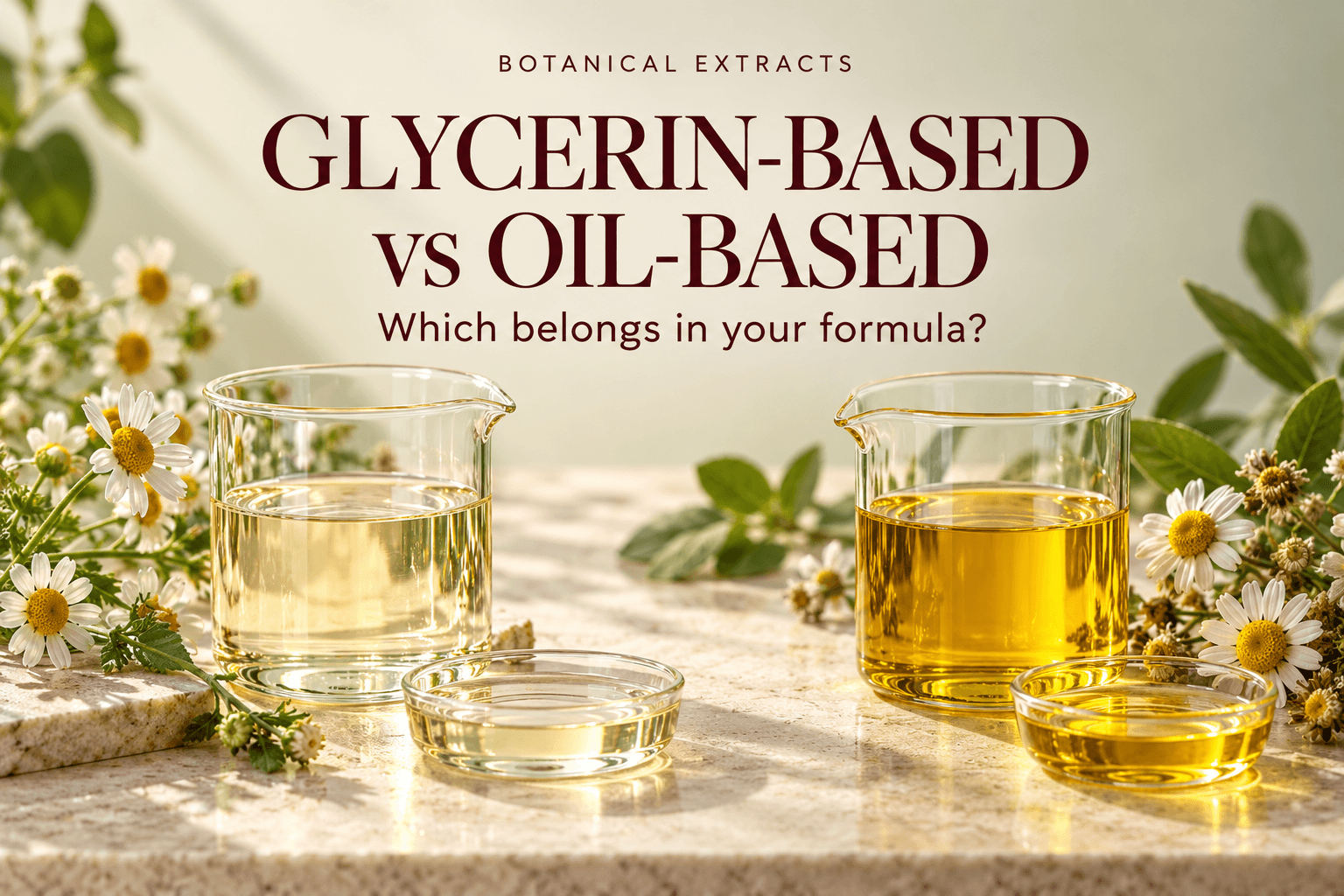
That distinction matters when you are developing a facial serum, body balm, scalp treatment, or moisturizer. Glycerin-based botanical extracts generally belong in water-containing systems, while oil-based botanical extracts are designed for compatible oil phases. Choosing between them starts with your formula’s structure, followed by the extract’s technical specifications.
What Are Glycerin-Based Botanical Extracts?
Glycerin-based extracts contain botanical material carried in glycerin, often combined with water. These blends are commonly called hydroglycerin extracts.
Glycerin acts as a humectant, helping attract and hold water. Depending on the plant and extraction process, glycerin-and-water mixtures can also recover certain plant constituents, including phenolic compounds. Their composition varies with the solvent proportions and processing conditions.
These extracts are useful candidates for toners, gels, water-based serums, cleansers, and emulsions. For example, COCOJOJO Gotu Kola Extract lists glycerin, water, and Centella asiatica extract, with incorporation into the cool-down water phase described on its product page.
Remember to account for the glycerin contributed by your extract when assessing the finished product’s feel. Several glycerin-containing ingredients can collectively make a formula tackier than intended.
What Are Oil-Based Botanical Extracts?
Oil-based extracts supply botanical constituents in an oil-compatible format. Some are made by infusing plant material into a carrier oil; others use different extraction methods before being incorporated into an oil carrier.
They are useful candidates for facial oils, massage oils, balms, and anhydrous body butters. COCOJOJO’s Oil Base Extract collection includes botanical materials described for these applications.
Check whether the supplier describes an ingredient as oil-soluble or oil-dispersible. Those terms do not guarantee the same clarity or settling behavior. An extract that works in an opaque balm may need additional evaluation in a transparent facial oil.
An oil-based botanical extract is also different from an essential oil or a plain seed oil. Confirm the complete composition before treating these ingredients as interchangeable.
Does One Format Deliver More Botanical Benefits?
There is no universal winner.
Extraction conditions influence which constituents are recovered and in what amounts. Research on glycerol-based botanical extraction shows that solvent composition and processing conditions can change extraction performance. You therefore cannot assume that two extracts from the same plant contain equivalent amounts of the same compounds.
Likewise, a darker color, stronger scent, or thicker consistency does not establish greater effectiveness. Compare the extract concentration, any standardized marker compounds, and supporting evidence relevant to your intended use.
Choose by composition and documented performance, alongside compatibility with your formula.
Which Extract Belongs in Your Product?
For conventional formulations, these are useful starting points:
- Toners, water-based serums, and gels: Consider a water-compatible glycerin-based extract. Confirm its effect on clarity, pH, viscosity, and skin feel.
- Facial oils, balms, and anhydrous butters: Consider an oil-compatible botanical extract. Check its carrier, recommended concentration, and dispersion behavior.
- Creams and lotions: Either format may be suitable because emulsions contain both water and oil phases. Follow the extract’s incorporation instructions and evaluate the finished emulsion.
A glycerin-and-water extract should not be dropped directly into a simple facial oil or balm with the expectation that stirring will create lasting compatibility. Introducing it may require redesigning the formula, including its emulsification and preservation systems.
For smaller projects, explore a retail ingredient such as COCOJOJO Chamomile Extract, then confirm the current composition and usage instructions for the exact version you select.
What Should You Check Before Formulating?
Start with the full INCI composition, including the botanical, carrier, water, and any preservatives. Then review the supplier’s recommended usage range, solubility, processing temperature, and suitable pH conditions.
There is no single percentage or addition temperature that works for every botanical extract. Follow the documentation for your specific material and calculate additions by weight.
Request relevant technical information and a certificate of analysis when available. Your trial batches should assess separation, sediment, color, odor, viscosity, and packaging compatibility. Water-containing products also need appropriate pH and preservation evaluation.
For more guidance on ingredient selection, read COCOJOJO’s guide to choosing ingredients for skincare product development.
Preservation Still Depends on the Finished Formula
Do not assume a glycerin-based extract will preserve your finished product. Even if the supplied ingredient is microbiologically stable, dilution changes its environment.
Water-containing formulas need an appropriate preservation strategy supported by finished-product testing. The FDA’s guidance on microbiological safety in cosmetics identifies contaminated ingredients, ineffective preservation, packaging, and handling as potential contamination routes.
Anhydrous products also require a microbial risk assessment, particularly when water may enter during use. Antioxidants used to slow oil oxidation serve a different purpose from antimicrobial preservation.
Conclusion: Let Your Formula Guide the Choice
Choose a glycerin-based botanical extract when its composition and specifications suit your water-containing formula. Choose an oil-based extract when it fits your oil system and desired finish.
COCOJOJO offers both formats, giving formulators options across serums, creams, oils, and balms. Start with the product you want to create, review the exact ingredient documentation, and test a small batch before scaling. A well-chosen botanical should fit both your product story and the formula that delivers it.