
Introduction
Your cream looks beautifully smooth when you finish mixing. A few days later, oil begins collecting on top. What went wrong?
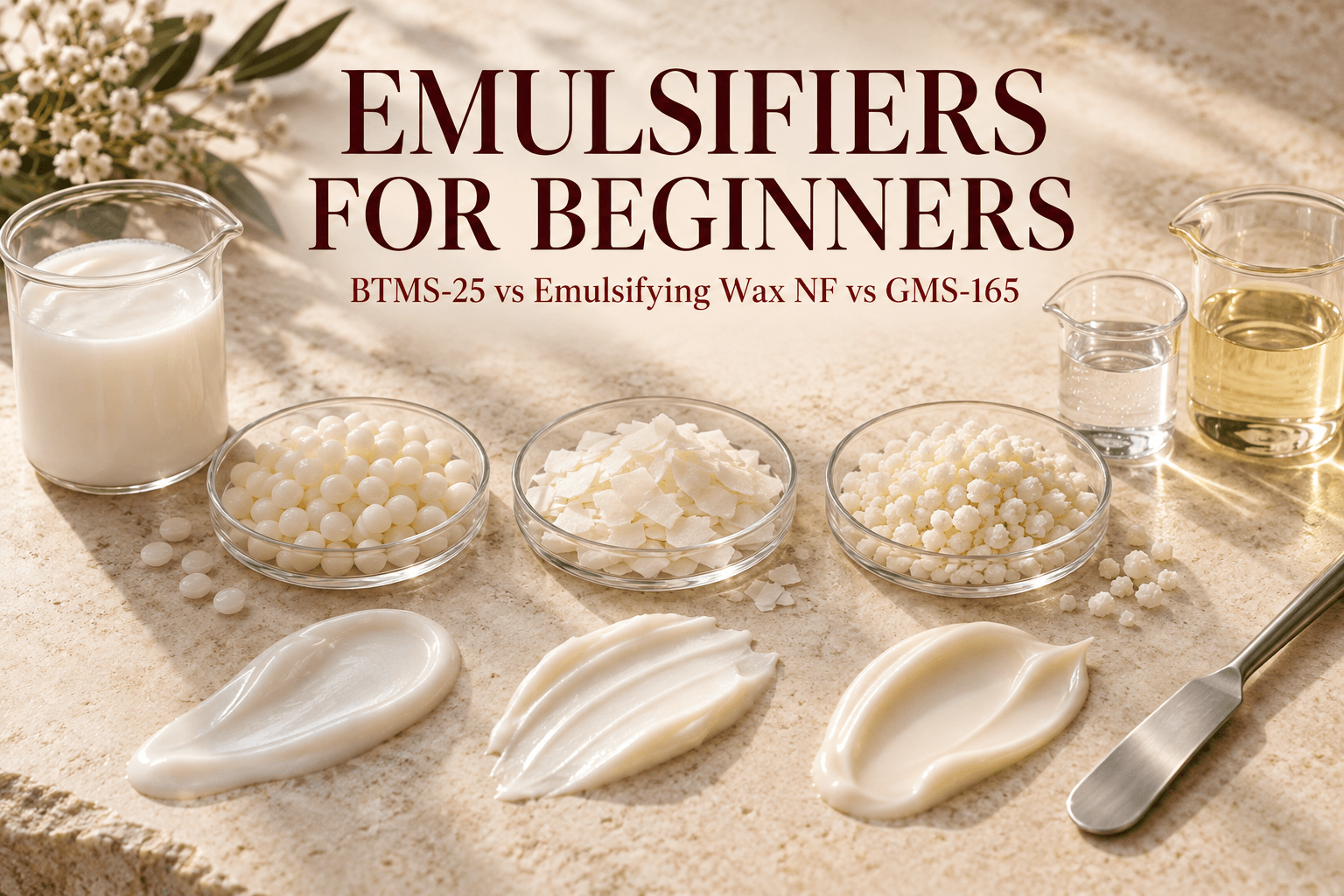
One place to investigate is your emulsifying system. BTMS-25, Emulsifying Wax NF and GMS-165 can help combine oil and water, but they bring different properties to a formula. Choosing between them starts with what you want to make: a detangling conditioner, a creamy body lotion or a moisturizer with a carefully adjusted texture.
Here is how to make that choice with more confidence.
What Does an Emulsifier Do?
Oil and water naturally separate. An emulsifier helps one disperse into the other as tiny droplets, supporting a uniform cream or lotion. The finished product’s stability also depends on ingredient proportions, processing, pH and the rest of the formula.
An oil-in-water emulsion contains oil droplets dispersed through a continuous water phase. All three ingredients in this comparison can be used in this type of system, although their conditioning properties and texture contributions differ.
A useful distinction: thickening and emulsifying are separate jobs. A thicker mixture is not automatically a more stable emulsion.
BTMS-25: Choose It When Conditioning Matters
BTMS-25 typically combines approximately 25% behentrimonium methosulfate with cetearyl alcohol. It is a cationic emulsifier, meaning its conditioning component carries a positive charge.
That makes it particularly useful for hair conditioners, where detangling, softness and wet combability matter. It can also create skin creams with a smooth, conditioned feel. The cetearyl alcohol contributes body and structure.
For a first rinse-off conditioner, COCOJOJO BTMS-25 is a relevant ingredient to explore.
Because it is cationic, check compatibility with negatively charged ingredients, including some surfactants and thickening polymers. Do not assume a lotion formula designed around a nonionic emulsifier will work unchanged with BTMS-25.
Emulsifying Wax NF: A Practical Starting Point for Creams
Emulsifying Wax NF is a nonionic emulsifying blend used to make oil-in-water creams and lotions. Common grades combine cetearyl alcohol with a polysorbate. Check the supplier’s exact composition because “emulsifying wax” alone does not identify every component. NF refers to National Formulary specifications.
It is a practical option when you want a conventional creamy texture for a body lotion, hand cream or moisturizer. Its fatty alcohol content helps build consistency, although the final thickness still depends on the complete formula.
Explore COCOJOJO Makeit Emulsifying Waxy NF when selecting ingredients for this type of project.
Unlike BTMS-25, a nonionic emulsifying wax does not supply the same positively charged conditioning system. It can emulsify a hair product, but it should not be treated as an equivalent detangling ingredient.
GMS-165: Emulsification with Room to Adjust Texture
GMS-165 combines Glyceryl Stearate and PEG-100 Stearate. This nonionic blend serves as a primary oil-in-water emulsifier for creams and lotions. It is different from plain glyceryl stearate, which should not be assumed to perform the same job by itself.
For formulators, its appeal is the ability to develop a silky emulsion while adjusting consistency through the wider formula. Depending on your target texture, that may involve a suitable fatty alcohol, gum or other compatible structuring ingredient.
COCOJOJO GMS-165 is listed as a primary emulsifier for creams and lotions with a silky texture. A smooth feel still needs to be confirmed in your own finished formulation.
Which Emulsifier Should You Choose?
Start with the product’s main purpose:
- For a detangling conditioner: Consider BTMS-25 for its conditioning function.
- For a first classic cream or body lotion: Consider Emulsifying Wax NF in a supplier-tested beginner formula.
- For a cream or lotion with more deliberate texture development: Consider GMS-165 with a compatible structuring system.
These are starting points, not guarantees of performance. Oil selection, emulsifier concentration and processing can change the result substantially.
COCOJOJO’s cosmetic emulsifier collection lets you compare these ingredient options before choosing a formula to develop.
Can You Substitute Them at the Same Percentage?
Do not assume they are interchangeable gram for gram.
Changing emulsifiers can alter charge, conditioning performance, fatty alcohol content, viscosity and stability. Even switching between two nonionic systems may require adjustments.
Use the recommended concentration for the exact grade you purchase and begin with a tested formula. Avoid a universal rule such as “every lotion needs 5% emulsifier.” The appropriate amount depends on the emulsifying system and the ingredients it must support.
When experimenting, change one variable at a time and record each batch by weight.
Beginner Mistakes That Can Spoil an Emulsion
Incomplete melting, unsuitable mixing and incompatible ingredients can all contribute to disappointing results. Follow the formula’s heating, combining and cooling instructions rather than relying on appearance alone.
If your cream separates, investigate the emulsifier choice, oil load and processing before simply adding more wax. If it feels overly heavy, review the total amount of fatty alcohols, butters and other structuring ingredients.
Also, an emulsifier is not a preservative. Water-containing creams and conditioners generally need an appropriate preservation system. The FDA’s guidance on cosmetic microbiological safety explains why microbial contamination matters. A smooth-looking product does not establish microbiological safety.
Before selling a finished product, assess stability, packaging compatibility and preservative effectiveness.
Conclusion: Match the Emulsifier to the Product
Choose BTMS-25 when conditioning and detangling are central to your formula. Consider Emulsifying Wax NF for a classic cream or lotion, and GMS-165 when you want to develop an emulsion with an adjustable texture system.
Start with a reliable formula, check the exact ingredient documentation and test your results. For more ingredient inspiration as you build your formulation knowledge, explore the COCOJOJO blog.