
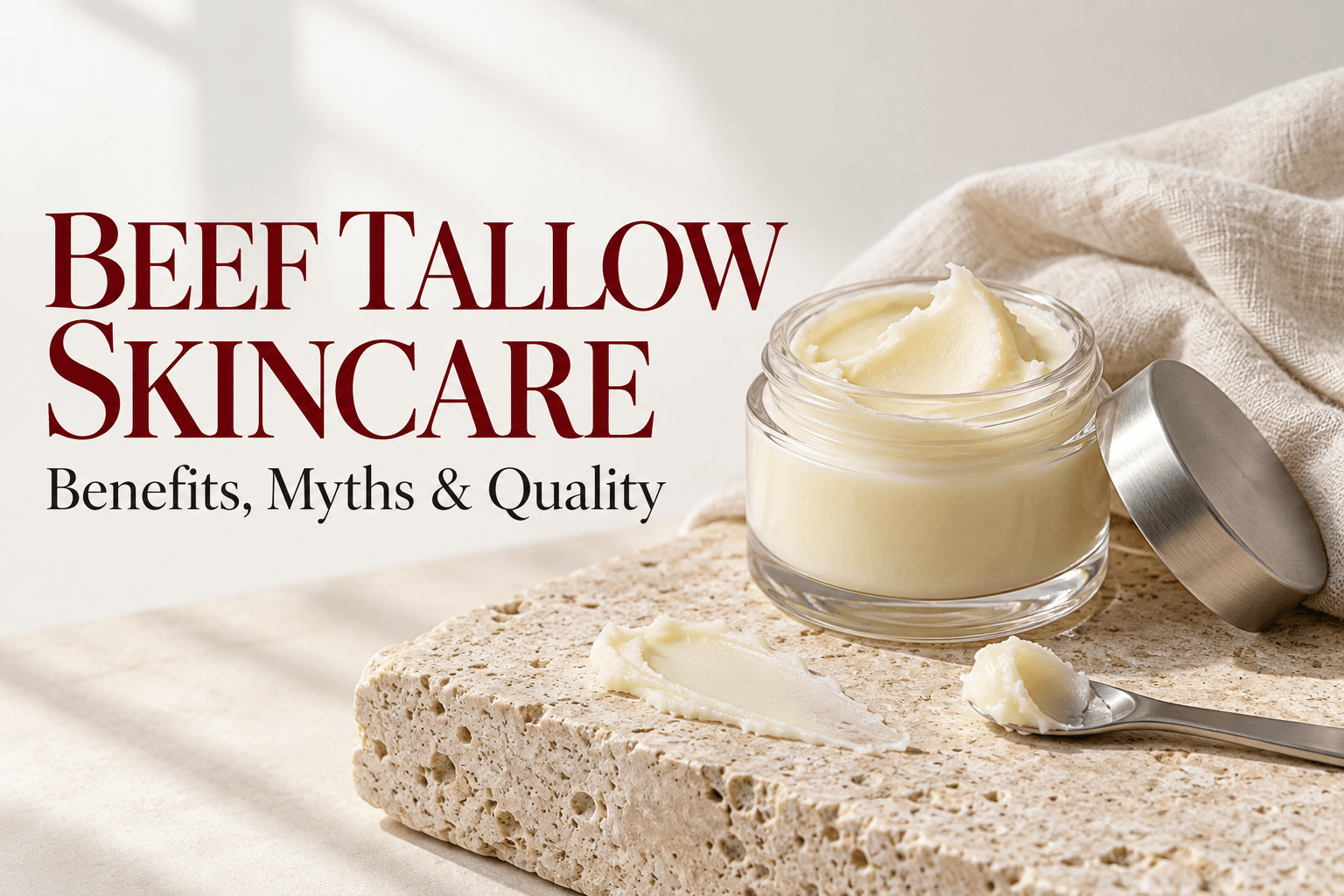
Introduction: Does Beef Tallow Deserve a Place in Your Routine?
An old ingredient has become a new skincare obsession. Beef tallow skincare promises a simple approach to moisturizing, with rich balms and short ingredient lists attracting plenty of attention.
But simplicity alone does not tell you whether a product suits your skin. Tallow may help soften dry areas, while claims about clearing acne or reversing aging need much stronger evidence. Understanding its realistic benefits and checking product quality can help you make a more confident choice.
What Is Beef Tallow?
Beef tallow is rendered cattle fat. Rendering separates the fat from surrounding tissue, producing an ingredient that typically becomes solid or semisolid at room temperature.
In skincare, it can provide richness and structure to balms and body butters. Its fatty acid profile includes oleic, palmitic, and stearic acids, although composition varies with sourcing and processing. A jar of pure tallow and a blended tallow moisturizer can therefore feel quite different.
Beef Tallow Benefits: What Is Realistic?
The most reasonable expectation is softer-feeling, moisturized skin. Tallow can act as an emollient, smoothing the feel of rough areas, and its occlusive character can help reduce moisture loss.
That richness may appeal to people with dry skin, particularly on hands, elbows, or legs. However, tallow does not supply water to the skin. A water-free balm may work best as a finishing layer over a suitable moisturizer.
Dermatologists describe these moisturizing properties while cautioning that a heavy texture can be unsuitable for some skin types.
What Does the Science Actually Show?
A published scoping review of tallow and skin identified substantial gaps in research, particularly studies of cosmetic use in humans.
This matters because an ingredient’s composition, traditional use, and popularity do not establish that it performs better than a well-formulated conventional moisturizer. Tallow’s appeal can reasonably center on its texture and skin-conditioning role, without presenting it as a clinically proven solution for every concern.
Three Beef Tallow Skincare Myths to Question
“Tallow treats acne or eczema.” Current evidence does not establish tallow as a treatment for these conditions. Moisturizing dry skin and treating a skin disease are different claims.
“Tallow works like retinol.” Naturally occurring nutrients do not establish retinol-equivalent activity. There is insufficient evidence to treat tallow as a substitute for a formulated retinoid.
“Natural means suitable for everyone.” An animal-derived ingredient can still cause an unwanted reaction, and a finished balm’s other ingredients also matter. The research does not establish universal safety or effectiveness. (Reference: PMC)
How to Choose Cosmetic-Grade Tallow
Treat cosmetic-grade tallow as a claim to investigate. The phrase alone does not demonstrate testing or FDA approval. In the United States, cosmetic businesses are responsible for safe, properly labeled products and adequate safety substantiation; FDA generally does not preapprove cosmetics.
When comparing products, look for: -
- A complete ingredient list: Distinguish pure tallow from blends containing oils, fragrance, essential oils, or other additions.
- Clear intended use: Choose a product sold with appropriate skincare directions rather than assuming cooking tallow is interchangeable.
- Traceable sourcing: Look for identifiable manufacturer information and batch or lot details.
- Quality documentation: For formulation ingredients, ask about specifications, a batch certificate of analysis, oxidation limits, and relevant contamination testing.
- - Storage and shelf-life guidance: Check how the product should be stored and when it should be used.
These are practical purchasing checks. They do not establish that every product bearing a cosmetic-grade label meets the same standard. “Grass-fed” or “organic” sourcing also cannot replace finished-product safety assessment.
Who Might Like Tallow, and Who Should Be Cautious?
People who enjoy a rich balm may find tallow appealing for dry body areas. Those with oily or acne-prone skin may find it too heavy, and some users can experience clogged pores or irritation.
Sensitive skin also deserves careful ingredient selection, especially when fragrance or essential oils are included. If you have an ongoing skin condition, seek guidance before using tallow as part of its care. (Reference: scripps.org)
How to Introduce a Tallow Balm
Follow the product’s directions and start with a small amount. Before broader use, test it on a small area twice daily for seven to ten days, watching for redness, itching, or swelling. This follows the American Academy of Dermatology’s guidance for testing new skincare products. Stop if a reaction develops. (Reference: aad.org)
Use clean, dry hands or a spatula, close the container after use, and follow its storage instructions. Keeping water out of the jar helps avoid introducing contamination. (Reference: FDA)
Explore Tallow Skincare With COCOJOJO
COCOJOJO offers Pure Beef Tallow and Whipped Tallow Balm Advance, giving shoppers options to compare when exploring this ingredient. Check each product’s current label and directions to choose the option that fits your preferences.
For more ingredient education and routine inspiration, explore the COCOJOJO skincare blog.
Conclusion: Choose Quality Before the Trend
Beef tallow can offer a rich moisturizing experience, but expectations should stay grounded. Its most credible appeal is helping skin feel softer, while broader treatment and anti-aging claims remain insufficiently supported.
Choose clear labeling, documented quality, and a texture your skin tolerates. Whether you explore a COCOJOJO tallow product or another moisturizer, a thoughtful choice begins with the complete formula and your skin’s response.